What is a KYC provider, and why do crypto
businesses need one?
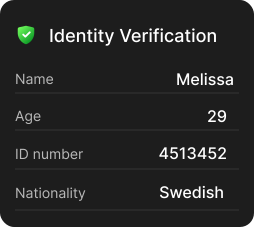
A KYC provider enables crypto and fintech companies to
verify the identity of their users in line with AML regulations. It
helps meet global compliance standards, reduce fraud risk, and maintain
trust with regulators and financial partners.
How does the KYC verification process work for end
users?
Users upload an identification document (passport, ID
card, or driver's license). The system validates authenticity,
cross-checks data consistency, and provides the result directly to the
business through a dashboard or API connection.
What documents are accepted for KYC verification?
Valid passports, national ID cards, or driver's
licenses. Documents must be unexpired, readable, and of good image
quality.
How long does KYC verification take?
The average verification time is 1-10 minutes,
depending on the document quality and queue. For API-based integrations,
completion may vary between 2 minutes and 6 hours.
What's the difference between KYC and KYB?
KYC (Know Your Customer) verifies individual users. KYB
(Know Your Business) checks legal entities - validating registration
data, company documents, directors, and UBOs against sanctions and PEP
lists.
What data sources are used for sanctions and PEP
screening?
Screening relies on official and open databases such as
OFAC, UN Security Council, EU Consolidated List, HM Treasury, ESMA,
Europol, FBI, Interpol Red Notices, Global PEP, and SECO Switzerland.
These lists are updated daily to maintain compliance accuracy.
Does the KYC solution support continuous
monitoring?
Yes. Businesses can enable ongoing monitoring for
verified users or entities to receive alerts when new matches appear in
sanctions or PEP lists.
What integration options are available for KYC
verification?
Two methods are available:
- API integration - for full control, branding, and
automated workflows.
- iFrame integration - for quick setup without complex
development. As part of AMLBot's compliance suite, both
options allow crypto businesses to integrate verification
seamlessly into their onboarding flow.
Is the provider compliant with FATF and EU AML
directives?
Yes. AMLBot's KYC and KYB services follow FATF
recommendations and EU AML Directives (5AMLD and 6AMLD), ensuring
regulatory alignment for global crypto businesses.
What reports and audit trails are available for
compliance teams?
Verification reports are available in PDF and CSV
formats and include timestamps, verification logs, and audit data - all
accessible through the AMLBot dashboard or via API.
How to choose the best KYC provider for a crypto
exchange or wallet project?
When evaluating providers, focus on API reliability,
data coverage, verification speed, monitoring options, and compliance
scope. AMLBot combines these features in one infrastructure-level
solution, helping crypto businesses stay compliant without slowing down
onboarding.
How does KYC automation through API improve user
onboarding speed?
Automated KYC checks reduce manual review, deliver
faster results, and minimize user drop-off during registration.
AMLBot's KYC API enables exchanges and payment platforms to verify
users in real time while maintaining global AML compliance.